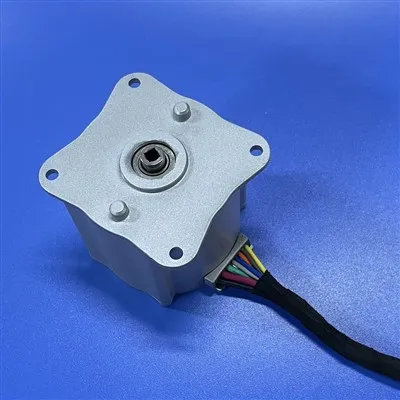
Hey there, let’s talk about something that’s probably not top of mind when you’re setting up a new collaborative robot, but will save you so much headache down the line: fault diagnosis for brushless motors. As someone who’s been a robot brushless motor supplier for years, I’ve seen way too many teams panic when their bot seizes up mid-production line, just because they didn’t catch a tiny motor fault early. Brushless motors are the workhorses of almost every industrial robot, cobot, AGV (automated guided vehicle), even those cute little educational robots you see in maker spaces. They’re efficient, low-maintenance, and pack a ton of torque in a small frame—perfect for robot arms that need to twist, lift, and move with precision. But when something goes wrong, it messes up everything, from assembly lines to medical robot functions. So today I’m breaking down how we (as motor folks) figure out what’s broken, why it matters, and what you can do to catch issues before they stop your whole operation. Robot Brushless Motor

First, let’s get one thing straight: diagnosing a brushless motor isn’t just guessing at why it’s not spinning. Unlike brushed motors, which have physical brushes that wear out over time, brushless motors use electronics to control the magnetic field, so faults can be in the motor itself, the drivers, the wiring, or even the robot’s control software. Over my years supplying these motors, I’ve found that most people jump to blaming the motor first, but 3 out of 5 times, the issue is something trivial—like a loose wire, or a driver setting that got out of whack. So let’s start with the basics: how do we even collect data to diagnose faults? Because you can’t fix what you don’t measure, right?
Most modern robot brushless motors come with built-in sensors, and that’s our first line of defense. We’re talking about things like Hall effect sensors, which tell the driver where the motor’s rotor is at any given time, and thermal sensors that monitor the motor’s temperature. Those sensors feed real-time data to the robot’s controller, so if something’s off, the controller flags an error code. But error codes only take you so far—like, if the code says “overheating,” is that because the motor is under too much load, or because the thermal sensor itself is broken? That’s where more advanced diagnosis comes in. We also use current and voltage monitoring, because brushless motors run on three-phase AC, so each phase should draw a consistent amount of current. If one phase is pulling way more or less than the others, that’s a red flag—could be a short in the winding, a loose connection, or a damaged phase wire. I remember a customer a couple years back, a small electronics assembly shop, who had their SMT robot arm seizing up every few hours. They thought it was a control board issue, but when we pulled current data, we saw phase 2 was drawing 2x more current than the others. Turns out, during a part change, a tiny piece of solder had splashed onto the motor’s phase wire, causing a partial short. Fixed that in 10 minutes, no need to replace the whole motor. That’s the kind of thing sensor data catches fast.
But built-in sensors only work if you’re using a smart motor, right? Some older robots use off-the-shelf brushless motors without any on-board sensors, so you have to do external monitoring. That’s where things like vibration analysis and acoustic sensing come in. Vibration analysis is super straightforward—all you need is a small accelerometer mounted on the motor housing. Healthy brushless motors have a consistent, low-level vibration pattern, like a quiet hum. If there’s a bearing fault, the vibration will spike at a specific frequency that you can pick up. Winding faults, on the other hand, create irregular vibration that changes with motor speed. Acoustic sensing is similar, but uses microphones to listen for unusual noises—like grinding, clicking, or high-pitched whines that aren’t normal. I once worked with a cobot maker who was getting a lot of warranty returns on their 6-axis arms. They thought the motors were defective, but when we tested the returned units with a vibration analyzer, we found that the bearings were wearing prematurely because of a tiny tolerance issue in the motor housing. They adjusted their assembly process, and those returns dropped by 80% within a quarter. That’s the value of proactive diagnosis, not just reactive fixes after a fault happens.
Then there’s back EMF (electromotive force) analysis, which is a big one for brushless motors. Wait, what’s back EMF? When a motor spins, it generates its own voltage, opposite to the voltage being applied to it. For a healthy brushless motor, the back EMF should be a smooth, sinusoidal (or trapezoidal, depending on the motor type) wave that matches the phase voltage. If there’s a winding fault, like a shorted turn, the back EMF gets distorted—you’ll see dips or spikes in the wave that aren’t supposed to be there. The cool thing about back EMF analysis is you can do it even when the motor isn’t powered up, which is perfect for diagnostic checks during maintenance breaks. A lot of our industrial customers do a quick back EMF test on every motor in their robot fleet during weekly downtime, just to catch winding issues before they cause a full failure. I should mention, though—this only works if the motor is in good physical shape, not stuck or damaged. If the motor is seized, back EMF won’t register at all, so you know something’s wrong with the mechanical side, not the electrical.
Now, let’s talk about the common faults we see most often, and how diagnosis methods fit into each. The number one fault I see with robot brushless motors is bearing failure. Bearings are the moving parts that let the rotor spin smoothly, and they take a lot of stress from constant use, heavy loads, and even dust or debris getting into the housing. How do you diagnose a bad bearing? Like I said earlier, vibration analysis is the go-to—you’ll see a distinct frequency peak at around 10-30 kHz, depending on the bearing size. Also, temperature will spike because a bad bearing creates more friction, so your thermal sensor will flag overheating. The fix here is usually replacing the bearing, not the whole motor, which is why early diagnosis saves our customers so much money.
Next up: winding faults. These happen when the copper wires inside the motor’s stator get damaged—could be from overheating, moisture, mechanical stress, or just wear over time. Winding faults range from partial shorts (as I saw with that solder splash) to full open circuits, where a wire breaks completely. Back EMF analysis is perfect for this, because the distorted wave is a dead giveaway. Current monitoring also works here—if one phase is drawing way more current than the others, that’s a sign that the winding is damaged and not conducting electricity evenly. Another way to catch winding faults is insulation resistance testing. You apply a low voltage between the windings and the motor housing, and if the resistance is lower than it should be, that means the insulation around the windings is breaking down, which can lead to a short.
Then there’s position sensor faults—Hall effect sensors, mostly. These are the little sensors that tell the controller where the rotor is, so the current can be switched between phases at the right time. If a Hall sensor fails, the motor can’t spin properly, or it might vibrate really bad, or just not move at all. Diagnosing this is pretty easy: you can check the sensor output with a multimeter or an oscilloscope as you spin the motor by hand. If you don’t get a consistent signal from all three (for a three-phase motor), that’s your problem. A lot of cheap robot repairs involve just replacing a faulty Hall sensor, which is way cheaper than replacing the entire motor.
Wait, I should also mention that some faults are combination issues. Like, a bad bearing can cause vibration that damages the windings, or a loose wire can lead to current spikes that overheat the sensor. That’s why diagnosis isn’t just running one test—you have to cross-reference data from different sensors. For example, if your error code says “overheating,” you check the current draw first to see if it’s a load issue or an electrical issue, then check the vibration to see if a bad bearing is causing extra friction, then finally test the windings and sensors. Skipping steps here leads to wrong diagnoses—like that cobot maker I mentioned earlier, they initially thought the motor windings were bad, but it was actually the bearings. That cost them thousands in unnecessary motor replacements until we walked them through the full diagnostic process.
Now, as a supplier, what do I recommend for our customers? Because at the end of the day, you don’t just want to know how faults are diagnosed—you want to prevent them, right? First, invest in smart brushless motors with built-in sensors. It’s a little more upfront cost, but the real-time data means you can catch faults before they cause downtime. Second, implement a regular maintenance routine that includes diagnostic checks: vibration analysis quarterly, back EMF testing semi-annually, and thermal/current checks every month. Third, keep good records of your motor’s performance—tracking current draw, temperature, vibration levels over time lets you spot trends. Like, if the vibration of a motor starts increasing 10% every month, you can schedule a bearing replacement during a planned shutdown, not when the motor dies mid-shift.
I also want to bust a common myth here: a lot of people think that once a brushless motor fails, you have to replace the whole thing. That’s not true! Most faults—bad bearings, faulty Hall sensors, loose wires, even partial winding shorts—are repairable, and repairable at a fraction of the cost of a new motor. The key is diagnosing the fault correctly, which is why working with a supplier that knows these motors inside and out is a game-changer. We see so many customers throw away a perfectly good motor because they couldn’t figure out what was wrong, when all it needed was a $10 bearing replacement.
If you’re reading this, and you’re dealing with robot brushless motor issues, or you just want to set up a diagnostic routine to prevent downtime, reach out. We’ve helped hundreds of different customers—from small cobot shops to large automotive assembly lines—diagnose and fix motor faults, and we can help you too. We don’t just supply motors; we know how they work, how they fail, and how to keep them running as long as possible.
Brushless Dc Motor References
- Bose, Bimal K. Modern Power Electronics and AC Drives. Pearson, 2002.
- Ertugrul, Nihat. "Fault Diagnosis and Condition Monitoring of Brushless DC Motors." IEEE Transactions on Industrial Electronics, vol. 51, no. 2, 2004, pp. 466-477.
- Tallam, Raju M., et al. "A Survey of Failure Detection and Fault Tolerant Control of AC Machines." IEEE Transactions on Industry Applications, vol. 41, no. 6, 2005, pp. 1501-1511.
- Rubaai, Ahmed, and David Cobbinah. "Intelligent Fault Diagnosis of Brushless DC Motors Using Adaptive Neural-Fuzzy Inference System." IEEE Transactions on Energy Conversion, vol. 22, no. 2, 2007, pp. 366-373.
Shenzhen HengDrive Technologies Co., Ltd.
Shenzhen HengDrive Technologies Co., Ltd. is one of the most professional robot brushless motor manufacturers and suppliers in China, specialized in providing high quality customized service. We warmly welcome you to buy the newest robot brushless motor in stock here from our factory.
Address: Building A & F, FuNing Hi-Tech Park, XinTian Road, FuHai Street, BaoAn District, ShenZhen, GuangDong Province, China.
E-mail: Marketing001@hengdrive.com
WebSite: https://www.hengdrivemotor.com/
